Bower Studio
-
2023 Community Development
-
2023 Kalkaringi, NT
-
2022 Cummeragunja, NSW
-
2021 Kalkaringi, NT
-
2021 Cummeragunja, NSW
-
2020 Kalkaringi, NT
-
2019 Kalkaringi, NT
-
2018 Suanum & 2019 Sirr, PNG
-
2018 Kalkaringi, NT
-
2017 Wadeye, NT
-
2016 Sipaia, PNG
-
2016 Wave Hill, NT
-
2015 Areyonga, NT
-
2015 Amoonguna, NT
-
2014 Suanum, PNG
-
2014 Titjikala, NT
-
2013 Belyuen, NT
-
2012 Sipaia, PNG
-
2012 Bellary Springs, WA
-
2011 Wakathuni, WA
-
2010 Gudorrka, NT
-
2010 Knuckeys Lagoon, NT
-
2010 Morobe Province, PNG
-
2009 Gudorrka, NT
-
2008 Gudorrka, NT
-
2008 Nong Tong Lim, Thailand
Aboriginal and Torres Strait Islander readers are advised that this website may contain images of people who have died.
-
About Bower
Bower Studios are a sequence of Master of Architecture build/consult/design projects at The University of Melbourne’s School of Design. They involve students working alongside indigenous groups in remote locations in Australia, Thailand and Papua New Guinea to improve their built environments.
-
Our Team
Bower’s leadership team demonstrates diverse and complementary skill sets. Most are ex-Bower graduates who excel at building community relationships and mentoring new student groups.
The Bower Studio thanks its sponsors past and present

- Wave Hill Walk-off Pavilions, Bower Studio, featured in Gunyah, Goondie + Wurley: The Aboriginal Architecture of Australia, 2022
- Architecture and Design, December 2022, Cross-cultural Collaboration on Gurindji Country, pp14-16.
- Architecture and Design, 26 May 2022, The River Land, Gina Dahl and Bower Studio
- Dezeen, 16 December 2021: The River Land (Karungkarni Arts Centre) by Gina Dahl
- Architecture & Design 11 September 2019: Retrospective showcases Bower Studio’s community projects [Read it on Architecture & Design]
- NITV Radio 10 September 2019: Architectural projects making a difference in remote communities [Read and listen on NITV Radio]
- Shepparton News 12 April 2019: VCAL students complete university subject [Read it on Shepparton News]
- Wave Hill Walk-off Pavilions, Bower Studio, referenced in Repair: Australian Pavilion, 16th International Architecture Exhibition, La Biennale di Venezia, 2018
- Wakathuni Early Learning Center, Bower Studio, in The Design-Build Studio: Crafting Meaningful Work in Architectural Education, 2018
- The National newspaper Papua New Guinea 20 December 2018: Aussie students build toilet, classroom for Tumarawa [Read it on The National]
- ABC Radio Darwin 4 July 2018: Interview with Bower Studio/University of Melbourne's David O'Brien
- Green Magazine 18 April 2018: Australian Pavilion at 2018 Venice Architecture Biennale revealed [Read it on Grean Magazine]
- Architecture AU 13 April 2018: Australian projects to hit the world stage at Venice Architecture Biennale [Read it on Architecture AU]
- The Fifth Estate 12 April 2018: Repair and nature-sensitive design at Venice Architecture Biennale [Read it on The Fifth Estate]
- ABC Radio Darwin 5 June 2017
- NT News 8 June 2017: New home to help save artefacts
- ABC Radio Darwin 19 June 2017
- Architecture AU 19 June 2017: Winners Revealed – 2017 NT Architecture Awards [Read it on ArchitectureAU] – Wave Hill NT
- Architecture & Design 19 June 2017: 2017 NT Territory Architecture Awards winners announced [Read it on Architecture & Design]
- Norwich University School of Architecture and Art Design/Build Symposium: April 14, 2017 [Watch on Vimeo]
- NU SoAA D/B Symposium - Relationship of D/B to Practice [Watch on Vimeo]
- ABC Radio Melbourne Breakfast 11 August 2016
- Central Australian Aboriginal Media Association Radio 11 August 2016
- Radio Larrakia 12 August 2016
- ABC Radio Darwin 20 August 2016
- Pursuit 22 August 2016: Indigenous Memory-making meets architecture [Read it on Pursuit]
- EMTV 14 December 2016: Custom-built toilets for Climate Change Adaptation at Morobeen Village
- National Newspaper Papua New Guinea 15 December 2015: Two new toilets in Sipaia to improve sanitation
- ABC Radio Sydney 21 April 2015
- National Indigenous Radio Service 23 April 2015
- ABC Radio Adelaide 23 April 2015
- ABC Radio Northern Territory 27 April 2015 [ Download MP3 (12.4MB) ]
- Koori Radio Sydney 20 April 2015
- SYN FM Melbourne 21 April 2015
- SBS Radio 23 April 2015
- Centralian Advocate 24 April 2015 [ Download as PDF ]
- MUSSE 15 April 2015: Students build shelter with remote Indigenous communities [Download as PDF ]
- The Age 8 May 2015: Architecture students create vital infrastructure in remote communities [Download as PDF ]
- World Architects eMagazine Top 10 worldwide design/build programs that are making a difference.
- Pursuit Magazine, Times Higher Education Supplement March 2014 Indigenous Housing by Design
- Architecture and Design 12 May 2014 Indigenous Outdoor Housing Designed by Architecture Students
- ABC Darwin 6 May 2014
- ABC Alice Springs 6 May 2014
- Darwin Sunday Territorian 18 May 2014
- Koori Mail 21 May 2014
- Centralian Advocate 9 May 2014
- MUSSE May 12, 2014 Designing and building living spaces for remote communities | MUSSE
- Sanctuary Magazine Issue 26 Autumn 2014 Humanitarian Architecture
- ABC Darwin 18 September 2013
- Koori Mail
- Wagaitear Vol 12. No 10. October 2013
- Melbourne University Magazine August 2013 Building for Indigenous Communities
- CSHE 2013 Using ‘real world’ experiences for student learning
- Victorian Architect Winter 2012
- Gumala Radio 29 June 2012
- Architecture and Design’ 16 July 2012 Architecture students collaborate with Pilbara's Indigenous community on new hall
- Container Architecture ‘ArchiTel TV’
- Koori Mail July 11 2012
- Post-Courier 22 November 2012
- MUSSE Jul 24, 2012 Guest Column with Dr David O'Brien | MUSSE
- MUSSE Aug 8, 2012 Architecture, Building and Planning academic honoured by Rio...
- MUSSE Nov 12, 2012 Recognising excellence in teaching | MUSSE
- The Age Newspaper 18 July 2011 Students help build better future for isolated children
- ABC Radio National ‘Bush Telegraph’ 8 July 2011
- ABC Radio North West 27 June 2011
- SBS Radio ‘Living Black’ 22 June 2011
- The Age Newspaper 21 June 2011
- Visions July 15 2011 Construction for Community Podcast
- Pilbara Echo 16 July 2011 Official Opening of the Gumala 0-5 Studio
- ArchDaily 18 July 2011 Early Childhood Learning Centre
- Koori Mail 30 June 2010
- SBS ‘Living Black’ 22 August 2010
- SBS ‘News’ 22 August 2010
- ABC Darwin 18 May 2010 Shipping Containers Help Local Community.
- The Age 6 July 2010
- The Age Voice Vol 6. No 8. September 12 2010 Shelter, Space and a Community Place
- Visions Episode 85. September 17 2010 Making of a Media Box
- Open Architecture Network 2010 Gudorrka and Knuckeys Lagoon Media Boxes.
- ABC Triple J ‘Hack’ 24 August 2009.
- ABC Darwin ‘Morning Show’ 16 June 2009
- ABC1 ‘Stateline’ 3 July 2009
- ABC Radio ‘Connect Asia’ 19 October 2009
Bower Studio
2022 - University of Melbourne Excellence Award
Excellence in Placed-based Initiatives – Cummeragunja Project Team - a collaboration with the Cummeragunja Community, Bower Studio at the Faculty of Architecture, Building and Planning, and the Academy of Sport, Health and Education.
2018 - Exhibited at Venice Architecture Biennale
The Wave Hill Walk-off Pavilions were selected for the ‘Repair’ exhibition at the Australian Pavilion at the Architecture Biennale, Venice, Italy.
2016 - Yali-McNamara Award for Small Project Architecture
Australian Institute of Architects prize for the Walk-off Pavilions on Gurindji Country, Northern Territory.
2015 - Innovation Award - Planning and Building
Australian Regional Development (ARDC) for HomePlus projects 2013, 2014
2014 - Vice-Chancellor’s Engagement Award
This award recognized the Bower Studio’s innovative HomesPLUS projects at the Beyuen and Titjikala (NT) communities. It noted the team’s capacity to positively engage with community groups and industry partners.
David O’Brien
Rio Tinto Excellence and Innovation in Indigenous Higher Education 2012
"David O'Brien is to be congratulated for developing and delivering such a program over many years, and for involving a wide range of community and corporate partners in order to help support it. The Rio Award is a well-deserved accolade for this excellent program."
Australian Government Office for Learning & Teaching Citation for Outstanding Contributions to Student Learning 2012
For innovative and collaborative approaches to engaging architecture students with Indigenous communities to realise development projects alongside local partners.
Neville Quarry Architectural Education Prize – Commendation 2012
Jury Chair Brian Zulaikha noted in the commendation citation "The Jury acknowledged Dr O’Brien’s dedication to research and his integration of this into the Bower Studios program. The studios produce a student culture which is deeply interested in the indigenous architecture of many communities. Students have the unique experience of engaging with the community to deliver meaningful outcomes as well as the practical application of going on-site to construct the designs."
Student Awards
Gina Dahl
2022 DesignInc Positive Legacy of Design Award
Dean’s Honours List, awarded for the best design from any discipline that shows the potential to have positive social and ecological outcomes or legacy
Victoria King and Daniel Bisetto
2018 John McIlwraith Award
Victoria and Dan consulted with Gurindji, Warlpiri and Mudburra people to co-design the arts centre renovation.
Georgia Hall and David Gerber
2017 John McIlwraith Award
This award supported Georgia and David conduct qualitative based post-occupancy studies at the 2018 Bower Studio project at Sipaia.
Matt Breen, Ilari Lehtonen and Trevor Galgal
2013 Dreamlarge Student Engagement Award
This award enabled students Matthew Breen, llari Lehtonen and Trevor Galgal to return to Papua New Guinea to research and refine the prototype composting toilet design built by the Bower Studio at the Sipaia Community in 2012.
Fiona Lew
2010 BlueScope Steel Glenn Murcutt Student Prize
Fiona was awarded the prize for her Bower Studio work designing Single Men’s Community at Gudorrka - an examination of suitable self-help housing for itinerant men near Darwin. The awards jury said they “appreciated Fiona’s resolution of simple shelter housing that is sufficiently flexible to accommodate indigenous patterns of living with elements that can be added or subtracted”.
Allison Stout, Charlotte Fliegner & Karina Piper
2008 University of Melbourne Knowledge Transfer Award
Bower Studio students Allison, Charlotte and Karina received funding to continue the project into 2009, liaising with the Gudorrka community to renovate House 8.
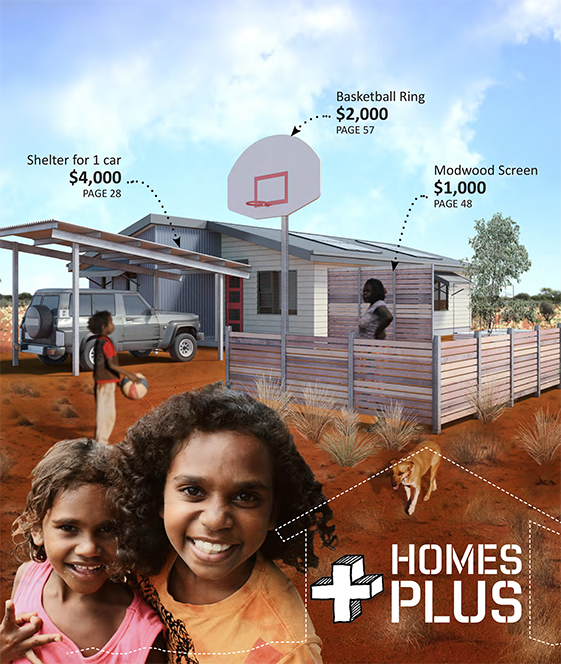
What is Homes Plus?
Homes Plus is a new way of delivering housing options for Indigenous Communities in Australia. This program considers both the house itself but also the additional items you may wish to add to your house to make it your home. Items such as shading, screening and outdoor shelters for cooking or for your cars will help to make your new home more suitable for the way you live.
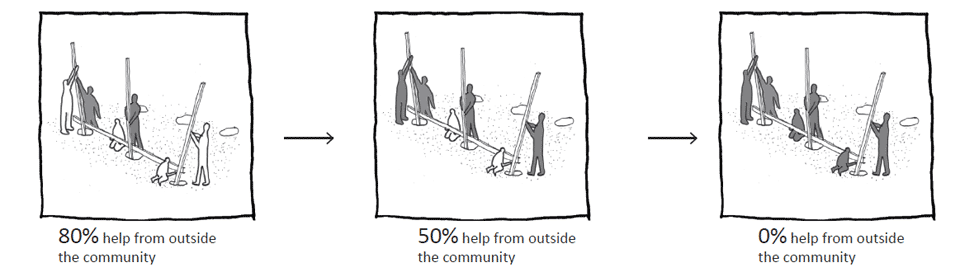
Working through this website (or the catalogue) you will see you can select a home and a number of add ons, depending on your needs and budget. The Add Ons will be delivered to site with your home and you will be joined by the Homes Plus team to build them yourself, or with a few friends, depending on how big the project is. For the first few Add Ons, the Homes Plus team will be there to help out but before long you and your friends will have all the skills you need to build the Add Ons yourselves.
How can I get involved?
If you are eligible for a new home, contact your Aboriginal Corporation to see if they are involved in the project. In the mean time, you can view the Homes and Add Ons on the website (or in the catalogue) to see what Home and Add Ons will be best for you.
Contact Us
If you have any questions or need more information, please contact the Homes Plus team by email.
Dr. David O'Brien
- Phone
- 03 8344 8761
- djobrien@unimelb.edu.au
- Address
- Melbourne School of Design (Building 133)
University of Melbourne VIC 3010
AUSTRALIA
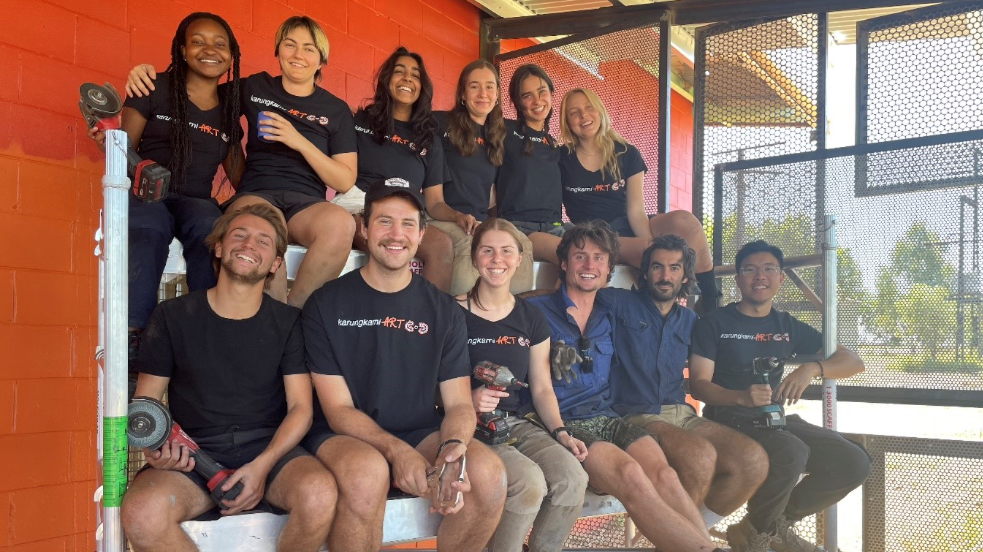
Karungkarni Arts Centre
Semester 2, 2024
The award-winning Bower Studio was formed in 2008 and works with indigenous communities in remote Australia and Papua New Guinea. What makes this program so relevant is the way students travel to these communities to work alongside locals on important community development projects.
Teams of Bower Studio students have co-designed and co-built culture facilities with the Kalkaringi community since 2014. The relationship has strengthened year by year and several projects have now been completed.
We have been invited to compliment the work Bower Studio completed at the local Karungkarni Arts Centre in 2018 and 2023 when teams worked with the community to double the space available to artists in a culturally appropriate and sustainable way.
The artists have asked us to improve the exhibition spaces and storage facilities inside the arts centre so that the artworks can be displayed properly.
Consultations are on-going and we will have the required sketch designs and ‘kit-of-parts’ prepared in time for us to begin work on-site in Kalkaringi early in semester 2 2024. You will travel to the Northern Territory (Darwin) by plane before car-pooling and driving down to Kalkaringi for a ten-day site construction program.
Returning to Melbourne you will prepare your own design for new culture spaces following the community consultations that will occur on-site at Kalkaringi.
Eligibility
Masters level design students enrolled in Design C, D, E or Thesis at the Melbourne School of Design are eligible to join the program.
Applications
You can show your interest (and improve your selection chances) by sending an email directly to the Bower Studio team.
Tell us why you are excited about visiting remote parts of Australia and working with the Karungkarni mob. It would be good for us to know if you are applying to have this processed as a Design C, D, or E subject or if you would like to do the project as Design Thesis. Add your telephone number in case we have any questions.
Please be aware that this project includes extended time ‘on-country’, travel, hard work and some very basic accommodation and food. Check the student blog on the Bower Studio website to get some idea of the students’ experience.
FAQ
How do you travel to the community?
A lot of Bower Studio learning takes place ‘on-country’ and Kalkaringi is a long way away. Students fly to Darwin and car-share 4WD vehicles to travel to the community.
Where do we stay at Kalkaringi?
There is a shortage of housing and no hotels at Kalkaringi so we stay at the various campsites surrounding the community.
What if I haven’t got any camping experience?
No problem – we have had plenty of students joining us for their first camping trip. You will be in safe hands.
I understand that there is a lot of ‘hands-on’ building to do. Do I need to have building experience?
We will teach everyone how to safely use the tools required for the project. You will feel like a pro when you return!
Is it easy to make friends with the rest of the students?
A definite yes to this one. Really strong friendships have emerged within groups of Bower students as they share a lifechanging experience together.
How much will this cost?
The university is offering a $1000 bursary to participating students. This should be enough to cover your flights to Darwin and back and your share of the 4WD hire. You will need to cover fuel costs and your contribution to the food budget (around $600). Accommodation is free if you have your own tent, sleeping mat and bag.
Is there time for me to do any sightseeing at the national parks in the Northern Territory?
Yes previous student groups have extended the trip and visited various waterholes.
Further information
Contact Dr David O’Brien
Staff
The teaching staff includes David O’Brien, James Neil, Zoe Diacolabrianos (Bower 2013), and Gina Dahl (Bower 2021).